
Our hardware.
QLOOP, the controller that makes a real photonic chip work, and the chips we build to prove the technology. Each one shows the stage it has reached.
- Being built
- Designed and simulated. Built in-house from catalogue parts.
- Planned
- In design. We share more as the work progresses.
- Research
- A concept we are developing on the same platform.
Section 1: QLOOP
Section 1
Planned
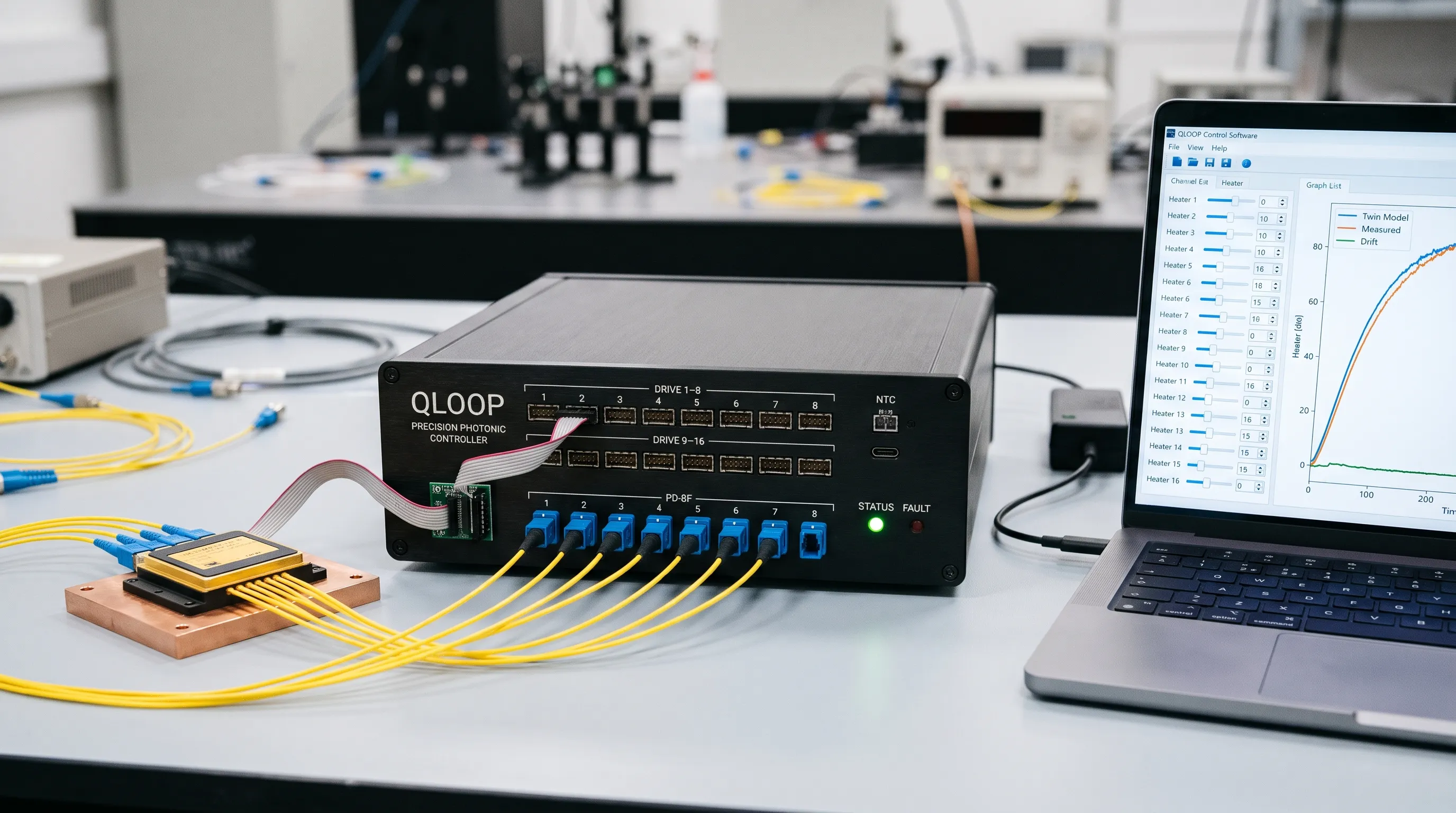
QLOOP is our closed-loop photonic chip controller: one box that makes a photonic chip usable. It drives the heaters, reads the light, calibrates the chip and holds the setting against drift.
QLOOP is built for after fabrication: model your chip in the twin, then drive and calibrate the real chip with the same software and compare it with the model. Before the chip exists, QLOOP’s heater drive, firmware, loop timing and safety limits are tested against the simulated chip on a resistor load board; light readout and the optics are checked only on the real chip. QLOOP grows out of the controller we built for VION, our proof of concept.
QLOOP is in development. We talk with groups preparing their first chip run about what they need from it.
Capabilities · Gen 1
Closed-loop lock-in calibration
Each heater gets a small dither at its own frequency. The firmware demodulates the photodiode signals to find each heater’s effect, then calibrates the chip and holds it against drift.
Precision heater drive
Current sinks set by a DAC control the heater power that tunes the chip’s phase, with a current limit on every channel.
High-resolution light readout
Transimpedance amplifiers feed a high-resolution ADC, so QLOOP reads both the output power and the weak monitor taps.
Temperature sensing and control
Thermistors on the chip and the plate let the loop separate thermal drift from real phase errors, and QLOOP drives the package’s own TEC.
Hardware safety, independent of software
If the PC or the firmware hangs, the heater rail is cut. A per-channel current clamp, a fault latch and over-temperature sensing on the drive transistors protect the customer’s chip, often their only die.
Twin-linked software
A Python library, a SCPI interface over USB and a GUI. The same calibration runs on the digital twin and on the real chip, and the software compares model against measurement through a hardware-in-the-loop link to q-twin.
Section 2: VION
Section 2 · Q1 2027
Being built
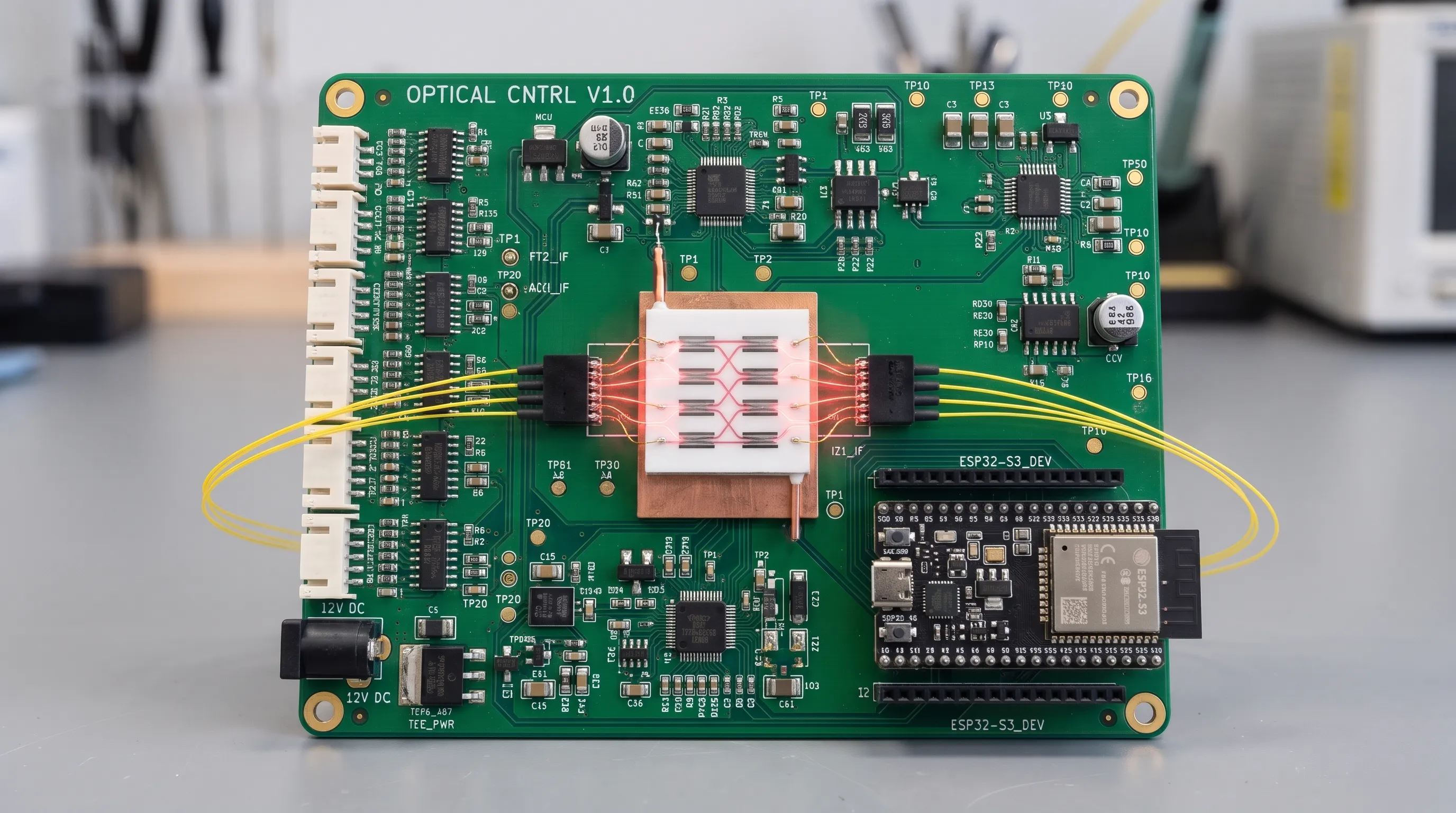
VION is our proof of concept, and it is deliberately small. It is a four-channel programmable mesh of six tunable interferometers, built in-house from catalogue parts.
It answers one question before we spend on a chip: can our own electronics and software set a programmable mesh, hold it steady and measure it?
VION proves the control chain, the calibration software and the measurement method that QLOOP and AXIOM will use.
4
light channels in VION, our proof of concept
Design
6
tunable interferometers in VION, built as six identical cells on a backplane
Design
< 2 %
mean error between the operation we ask for and the one the mesh performs, over 100 settings
TargetVION gate B3; no single setting above 5 %.
30 min
held on one setting with the lock on, within the programming error
TargetVION gate B4.
Section 3: AXIOM
Section 3 · Q3 to Q4 2027
Planned
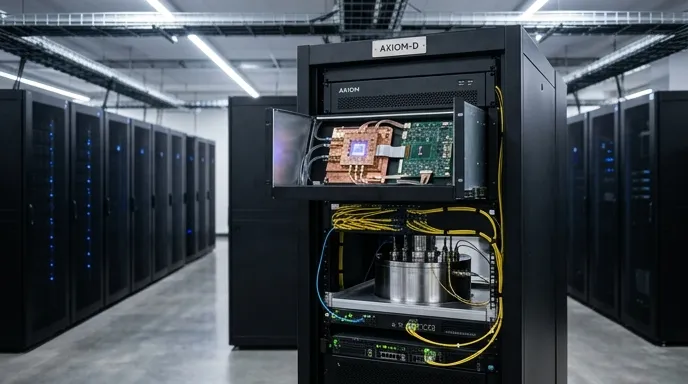
AXIOM is the product: a sixteen-path programmable light processor on a low-loss photonic material, with two photon-pair sources beside the chip. One chip does three jobs, switched in software:
- Quantum circuits for research labs, including two-photon logic gates
- Quantum machine learning
- An AI mode: a neural-network layer computed with light, as a research capability
It comes in two versions with the same chip. AXIOM-B, the base processor, fills four rack units, is air-cooled, and the customer brings photon sources and detectors; it is planned for Q3 2027. AXIOM-D, the data-centre system, adds photon sources, single-photon detectors, a time-tagger and a server in one rack; it is planned for Q4 2027. The chip runs at room temperature.
16
light paths in AXIOM, our programmable processor
Design12 paths as the fallback.
120
tunable interferometers in AXIOM
Design
3
operating modes on one AXIOM chip: quantum circuits, quantum machine learning, AI
Design
4U
of rack space for AXIOM-B, the base processor, air-cooled
TargetAXIOM-D, the data-centre system, fits one rack.
Section 4: XYRON
Section 4 · Q2 to Q3 2028 (targets)
Planned
XYRON is the hardware after AXIOM: a multi-chip processor, one core chip and three satellite chips with 64 to 128 modes, aimed at the first two-photon logic operation that works below the error-correction threshold.
It comes in the same two versions as AXIOM:
- XYRON-B, the base processor, targeted for Q2 2028. The customer brings photon sources and detectors.
- XYRON-D, the data-centre system, targeted for Q3 2028: XYRON-B with photon sources, detectors and control in rack form.
Fabrication starts only once our photon sources couple 70 % of their light into the chip. Size, price and rack footprint are not set yet; each VION and AXIOM measurement feeds the specification. XYRON is sized where photonic AI could beat GPU energy, if our zero-power memory layer and a fast modulator are proven.
Section 5: Memory layer for light
Section 5
Research
Today’s programmable photonic chips hold each setting by continuously heating a small part of the chip. That costs power, produces heat, and makes the chip drift as its temperature changes.
Our memory layer (patent filed) is designed to hold settings at near-zero power, so the chip keeps its configuration with no constant heating. The aim is processors that are more stable and lower-power, which matters when many chips share a rack.
June 2026
UK patent application filed.
On record
Section 6: Quantum data centers and classical optical processing
Section 6
Research
The long-term aim: processors designed toward standard rack integration for quantum data centers, with stated power and footprint.
The same platform can also process light for classical optical computing.
Section 7: Who it is for
Section 7 · Users
| Today | Tomorrow |
|---|---|
| Quantum research labs that need a programmable, room-temperature optical circuit for photonic quantum experiments | Quantum data centers: processors designed toward standard rack integration, with stated power and footprint |
| University and national-lab groups working on quantum optics and photonic computing | Classical optical processing on the same platform |
Interested in early access or collaboration? We are speaking with research groups about testing and first applications.
Marks beside the figures on this page:
- Design
- A property of our design.
- Target
- What we are aiming for.
- On record
- A matter of public record.